If you have ever run traffic to different verticals through Facebook, Google Ads, Moloco, or similar sources, you have probably seen tutorials that place a mobile app or a PWA between the creative and the advertiser's product.
That is why app rental for traffic arbitrage has grown into a market of its own. For a relatively small fee, specialized services handle development, publishing, maintenance, and part of the technical workload that would otherwise fall on the media-buying team. The trade-off, of course, is that convenience comes with limits.
Why apps are used in traffic arbitrage
Pre-landers almost always make the funnel worse, so the desire to shorten it is understandable. At the same time, traffic arbitrage has one important constraint that keeps pushing teams toward apps: bot traffic.
Apps are useful here because a bot that can install and properly launch an app is more expensive and less common than one that only scans a landing page. Without launching the app, it often cannot even obtain the final offer URL. In practice, that means some low-quality traffic gets filtered out before it reaches the tracker.
The main advantage of native apps is not appearance. It is the fact that they are harder to emulate, launch, and pass through automatically.
Native apps also make it easier to build advanced traffic-filtering logic, because they have access to more device-level signals: screen size, battery state, connection type, and other indicators that can help identify suspicious behavior.
Attribution, naming, and "warming up" the user
Another advantage of apps is how ad networks treat them. Some traffic sources only support app campaigns, such as Google's Universal App Campaigns. In other ecosystems, the tools that arbitrage teams actually need only become available in app campaigns, such as Playable creatives in Meta Ads.
Attribution is another reason apps remain attractive. Ad networks are generally more willing to share signals about users who install an app, and those signals can be useful for optimization.
"Naming" is a campaign-naming convention that lets you route traffic based on values embedded in the campaign name. For example, your team is called Angels, and you rent an app from Devils Apps. A campaign name might look like angels_buyer1_LNtLfH, where angels identifies your team, buyer1 marks the buyer, and LNtLfH stores the campaign ID from the tracker. If everyone agrees on that format in advance, the rental service can automatically route traffic to https://angels.com/tracker/LNtLfH?sub2=buyer1.
In some traffic sources, naming is not just convenient. It is a practical requirement for clean routing and optimization.
There is also the "warming up" effect. For many users, Google Play and the App Store feel more familiar and trustworthy than an unknown domain. That does not solve everything, but it can reduce friction before registration.
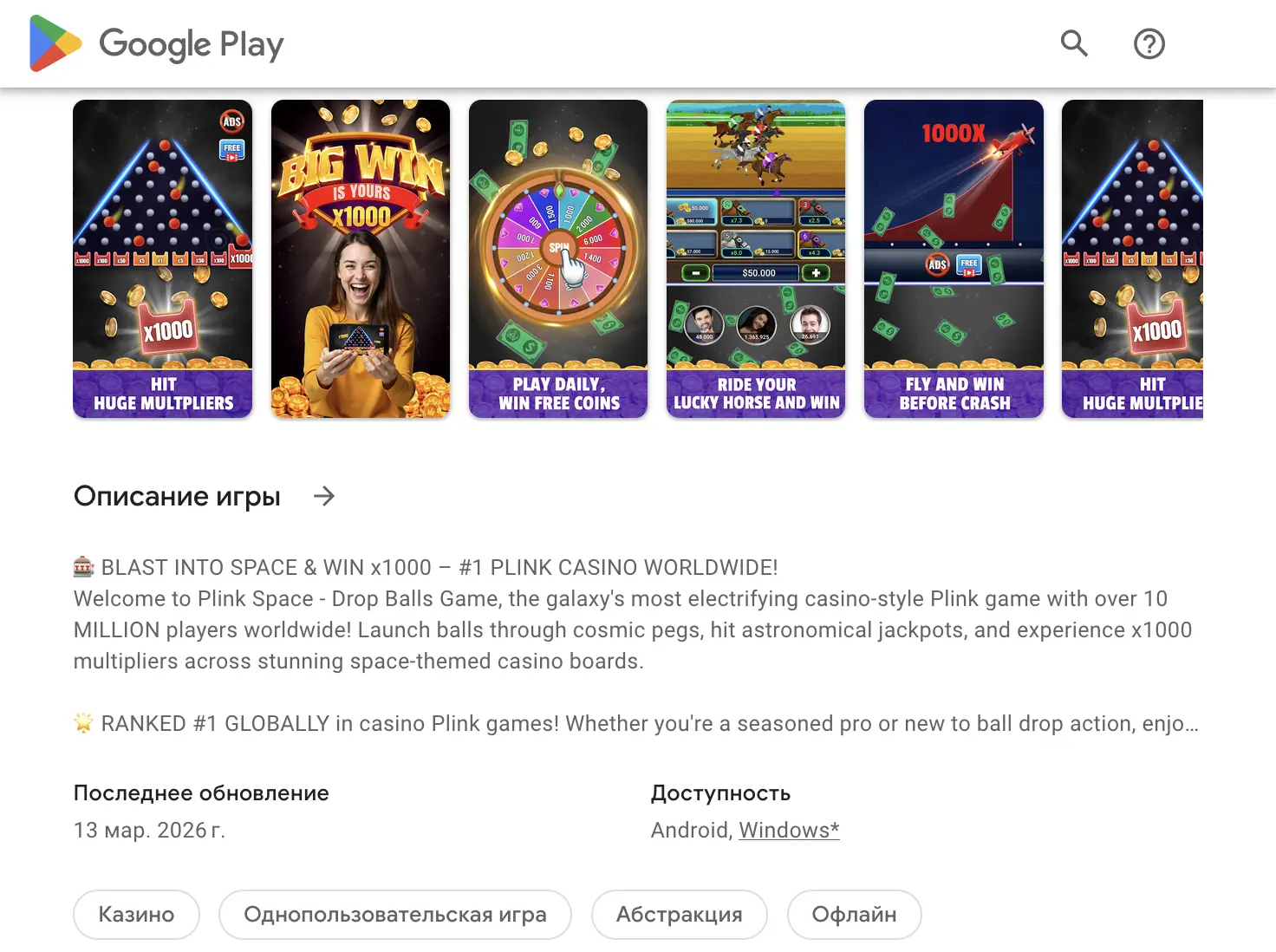
A well-designed store page can appeal to different audience segments in different ways. Stores also let you adapt the page content, for example by country.
Risks and downsides of app rental
Convenience comes at a price. Apps still help with bot filtering, but detection systems have improved as well. Where automated checks once struggled, manual moderation, anti-fraud systems, and AI-based classifiers now play a bigger role. As a result, the app-rental market in traffic arbitrage operates under constant pressure.
Anti-fraud systems and moderation often win that race. Platforms collect a large amount of behavioral data and can quickly identify and block arbitrage apps because many of them treat such apps as policy violations. That is why the average lifetime of an app in a store can be as short as a week, which is rarely enough to scale a campaign comfortably. You can get a sense of the broader trend on the AppBrain statistics page, which shows monthly publishing and removal volumes in Google Play.
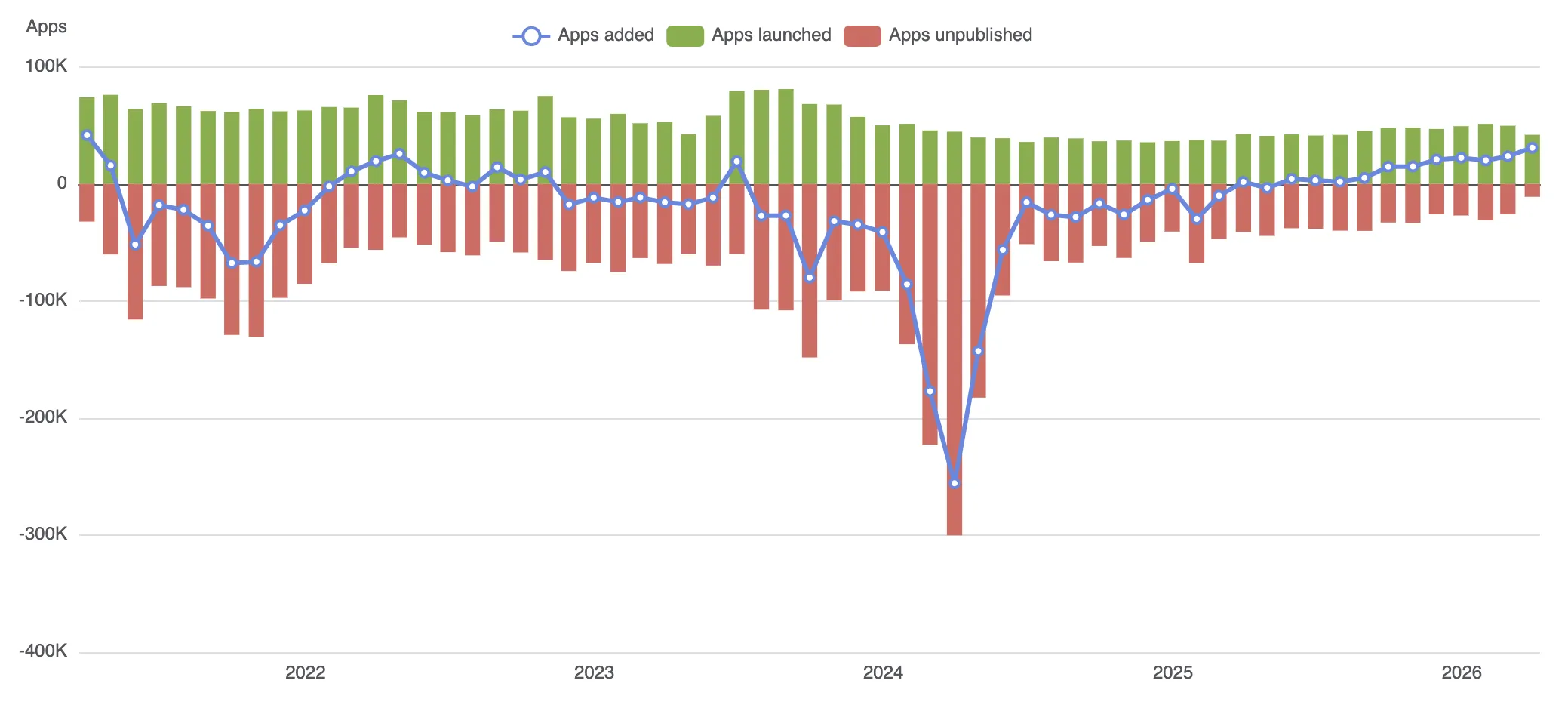
The chart shows that removals come in waves. Antivirus vendors add pressure too: Dr.Web, for example, has flagged such apps as Android.FakeApp, and other systems, including Google Play Protect, also react to similar builds. On VirusTotal, these apps often trigger detections from multiple antivirus engines.
In the age of AI-driven moderation, false positives are no longer rare. An app does not have to be outright malicious to get filtered or removed.
Because of that, building apps in-house is often harder than it looks at first. It is not just about writing the code. You also need to handle moderation, anti-fraud pressure, store compliance, and repeated replacements when a build gets flagged.
Can a PWA replace a native app?
At first glance, websites seem like the obvious way out: they are easier to build, easier to customize, and easier to move to a new domain if necessary. That said, sending traffic to yet another pre-lander has limited appeal. This is where progressive web apps, or PWAs, enter the conversation.
In essence, a PWA is a browser-based wrapper around a website that expands how the site can behave: it can place an icon on the home screen, offer limited offline behavior, and look a bit more app-like. In traffic arbitrage, though, many of these advantages have limited practical value:
- The home-screen icon is the only thing that really looks useful.
- PWA support on iOS differs noticeably from Android and even varies from browser to browser.
- The address bar remains visible because of security restrictions.
- Offline mode is rarely useful in arbitrage flows because the product itself still depends on a connection.
Compared with a native app, a PWA loses the main advantage: it has very limited access to the device, so it is much less effective as an anti-bot layer. On top of that, it remains a browser technology, which means behavior can differ across platforms and browsers. That creates a real risk of technical issues even at the installation stage.
A PWA is a lighter and cheaper alternative to a native app, but it usually gives up control, anti-fraud depth, and consistency.
Even so, many services rent out PWAs as well. The format stays popular because it is simple, affordable, and fast to launch.
When app rental makes sense
In practice, app rental for traffic arbitrage is a way to get ready-to-use inventory without spending months building everything yourself. Media buyers do not have to solve publishing, maintenance, and replacement on Google Play and the App Store on their own, because the provider handles most of that work.
Rental services usually offer several pricing models: subscription, CPI, or limited free access. If you want to compare terms, platform support, and payment formats, the easiest way is to use the app rental services catalog.
Naming conventions also make it possible to run and optimize campaigns for multiple buyers or even multiple teams at once. And if the native-app market feels too unstable, a PWA can be a reasonable alternative with a lower entry barrier, even if its capabilities are more limited.